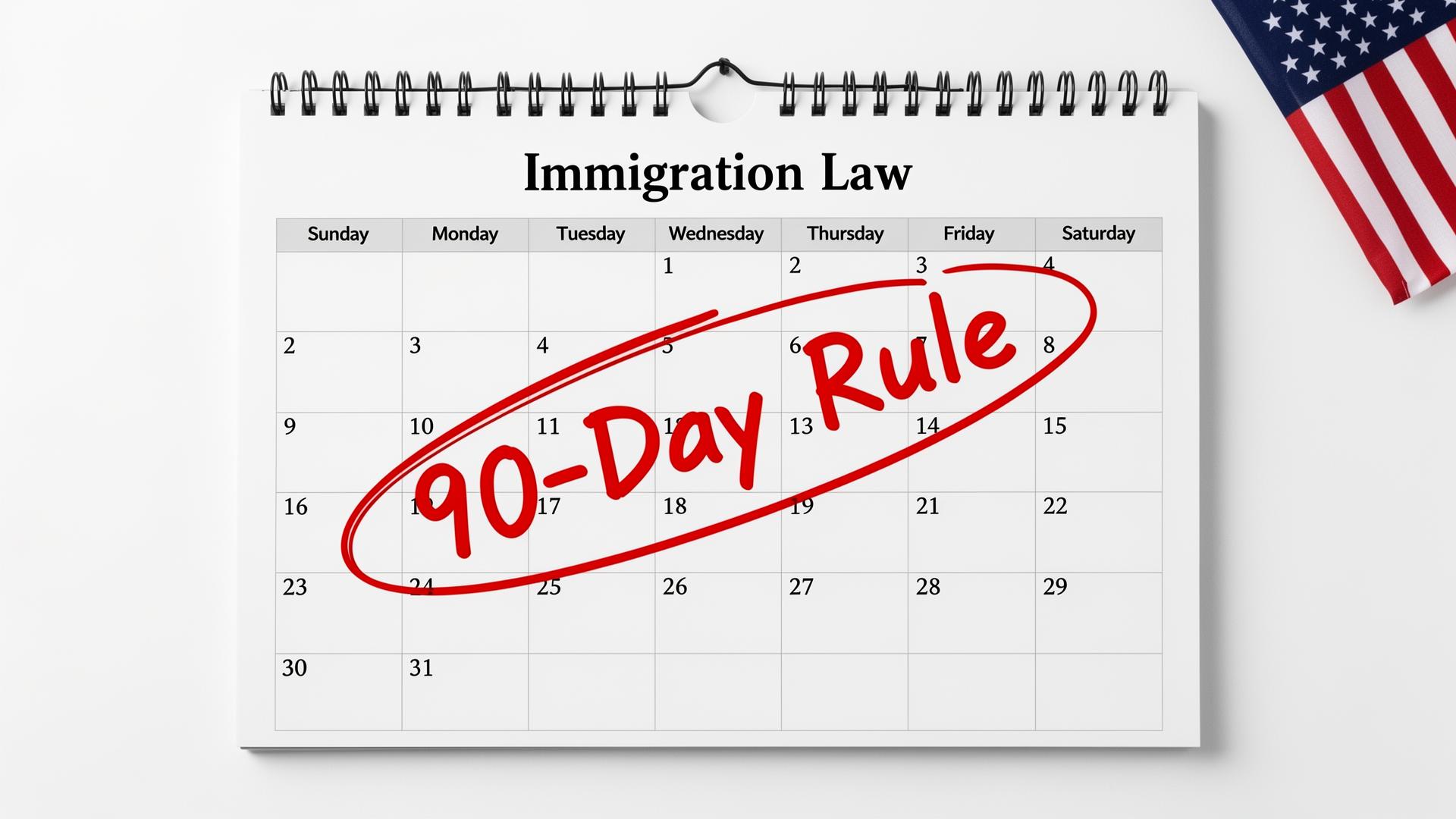
The 90-day rule is a Department of State guideline (not a binding USCIS rule) used to evaluate potential misrepresentation when someone enters the U.S. on a temporary visa and then gets married or applies for a green card within 90 days of arrival. If you take these actions within that window, immigration officers may presume you misrepresented your original intentions—which can result in your green card application being denied or even a permanent bar from the United States.
⚠️ Important clarification: The 90-day rule applies to people applying FOR a green card (adjustment of status), NOT to people renewing an existing green card. If you already have a green card and are filing Form I-90 to renew it, the 90-day rule does not apply to you.
[Start your green card renewal packet →](/get-started)
Quick Answer: What Is the 90-Day Rule?
The 90-day rule is a Department of State (DOS) guideline that creates a presumption of misrepresentation if someone enters the U.S. on a temporary visa (tourist, student, etc.) and then:
- Gets married to a U.S. citizen or permanent resident, OR
- Files for a green card (adjustment of status)
...within 90 days of arrival.
Key point: This is NOT a binding rule for USCIS. In 2021, USCIS removed all references to the 90-day rule from its Policy Manual. However, USCIS officers can still evaluate whether you misrepresented your intentions based on the totality of circumstances—the 90-day timeframe remains a useful guideline for avoiding scrutiny.
Who Does the 90-Day Rule Apply To?
The 90-day rule applies to nonimmigrant visa holders who enter the U.S. with "single intent"—meaning they represented that they would leave after their temporary stay.
Affected Visa Types (Single Intent)
These visa holders must demonstrate they intend to leave the U.S.:
- B-1/B-2 tourist and business visas
- F-1 student visas
- J-1 exchange visitor visas
- M-1 vocational student visas
- ESTA/Visa Waiver Program visitors
- TN NAFTA professionals
- Most other temporary visas
NOT Affected (Dual-Intent Visas)
These visa types allow immigrant intent from the start—you can pursue a green card without it being considered misrepresentation:
- H-1B specialty occupation work visas
- L-1 intra-company transfer visas
- K-1 fiancé visas (designed for marriage and green card)
- K-3 spouse visas
- V visas (for spouses/children of permanent residents)
Note on O-1 and E visas: The O-1 (extraordinary ability) and E-1/E-2 (treaty investor/trader) visas have some dual-intent characteristics. While not explicitly exempt, O-1 holders are generally not penalized for pursuing a green card in the same way B-2 holders would be. Consult an immigration attorney if you hold one of these visas.
What Actions Trigger the 90-Day Rule?
Within the first 90 days of entering the U.S., these actions raise red flags for single-intent visa holders:
- ❌ Getting married to a U.S. citizen or green card holder
- ❌ Filing Form I-485 (adjustment of status to get a green card)
- ❌ Working without authorization
- ❌ Enrolling in school without proper status change
- ❌ Taking up permanent residence
If you do any of these within 90 days, immigration officers may presume you planned to do this all along—meaning you potentially misrepresented your intentions when you applied for your temporary visa or entered the country.
Understanding the Legal Framework
It's a DOS Guideline, Not a USCIS Rule
This is an important distinction:
- Department of State (DOS): Uses the 90-day rule as binding guidance for consular officers when evaluating visa applications abroad
- USCIS: Is NOT bound by the 90-day rule. In 2021, USCIS removed all references to it from their Policy Manual
However, this doesn't mean USCIS ignores timing. Their Policy Manual states they "may find that an applicant made a willful misrepresentation due to a status violation or conduct in the United States that is inconsistent with the applicant's prior representations, especially where the violation or conduct occurred shortly after admission."
Translation: USCIS looks at the totality of circumstances, not just a strict 90-day cutoff. But timing still matters—actions taken very shortly after entry are more likely to raise suspicion.
What Replaced the 30/60-Day Rule?
Before September 2017, the DOS used a "30/60-day rule":
- Actions within 30 days = presumed misrepresentation
- Actions between 30-60 days = suspicious but not automatic
- Actions after 60 days = generally not problematic
In September 2017, this was replaced with the stricter 90-day rule, extending the presumption window to 90 days.
Consequences of a Misrepresentation Finding
The consequences of being found to have misrepresented your intentions can be severe:
- 🚫 Green card application denied
- 🚫 Current visa revoked
- 🚫 Found inadmissible under INA 212(a)(6)(C)(i)
- 🚫 Potential permanent bar from entering the U.S.
- 🚫 Deportation proceedings
- 🚫 Difficulty obtaining future visas
A finding of willful misrepresentation can result in a lifetime ban, though waivers (Form I-601) may be available in some cases for qualifying family relationships.
How to Avoid Problems with the 90-Day Rule
If you're planning to apply for a green card after entering on a temporary visa:
1. Wait at Least 90 Days (If Possible)
Wait at least 90 days after your most recent entry before filing for adjustment of status or getting married. This doesn't guarantee approval, but it removes the automatic presumption of misrepresentation under DOS guidelines.
💡 Important: Even after 90 days, USCIS can still investigate your intent. The difference is that after 90 days, there's no automatic presumption—the burden shifts, and officers must have other evidence to conclude you misrepresented your intentions.
2. Be Truthful at Entry
Never lie to a Customs and Border Protection (CBP) officer about your intentions. If you're asked "What is the purpose of your visit?" and you answer "tourism" while secretly planning to get married and file for a green card, that's misrepresentation.
If your intentions genuinely change after you enter, that's different—and perfectly legal.
3. Keep Evidence of Your Original Intent
Maintain documentation showing you truly intended to return home when you entered:
- Return flight tickets (booked before entry)
- Ties to your home country (job, property, family)
- Lease or mortgage payments in your home country
- Job you planned to return to
- University enrollment for the next semester
4. Document Any Change in Circumstances
If something unexpected happened that changed your plans after arrival, keep records:
- Medical emergency
- Job offer you couldn't refuse
- Genuine romantic relationship that developed after arrival
- Family emergency requiring you to stay
- Other unforeseen circumstances
5. Track Your 90 Days Carefully
The 90-day period starts from your most recent entry to the U.S. Add 90 days to your I-94 arrival date.
You can check your I-94 at i94.cbp.dhs.gov
⚠️ Multiple entries: If you leave and re-enter the U.S., the 90-day clock resets from your most recent entry date.
Special Situations
Immediate Relatives of U.S. Citizens
If you're an immediate relative of a U.S. citizen (spouse, parent of adult citizen, or unmarried child under 21), you have more flexibility. Immediate relatives can adjust status even if they entered without a visa in many cases, and USCIS tends to be more lenient.
However, the 90-day rule can still create problems—particularly if a consular officer believes you misrepresented your intent when you originally obtained your visa.
What If You Got Married Within 90 Days?
Getting married within 90 days isn't automatically fatal to your case, but you'll face additional scrutiny. Be prepared to:
- Explain how and when your relationship developed
- Provide evidence the marriage is genuine (photos, communication records, joint finances)
- Show you didn't enter with the preconceived intent to marry
- Demonstrate any change in circumstances that led to the early marriage
Many couples successfully adjust status after marrying within 90 days, but it requires careful documentation and often benefits from attorney guidance.
Does the 90-Day Rule Apply to Green Card Renewal?
No. If you already have a green card and are filing Form I-90 to renew it, the 90-day rule does not apply to you.
The 90-day rule is specifically about people who enter on temporary visas and then try to become permanent residents. As an existing green card holder, you already ARE a permanent resident—you're just getting a new card.
If you're renewing your existing green card (Form I-90), ImmigrationAlly can help you prepare an accurate, complete application. The 90-day rule doesn't apply to renewals—you're simply getting a new card.
Our bilingual document preparation service includes:
- ✅ Accurately completed Form I-90 — Current edition
- ✅ Cover letter to USCIS — Professional summary of your application
- ✅ Payment forms (G-1450 or G-1650) — 2026 compliant, for mail-in or online filing
- ✅ Form G-1145 — E-notification when USCIS receives your application
- ✅ Personalized document checklist — Based on YOUR situation
- ✅ Step-by-step filing guide — In English AND Spanish
- ✅ Real-time chat assistance — Get help when you need it
- ✅ Multilingual support — Spanish and English
- ✅ Easy-to-understand language — No confusing legal jargon
Use your packet to file online or by mail — either way, you'll have everything organized and accurate.
Start your green card renewal packet at ImmigrationAlly →
Sources
- USCIS Policy Manual, Volume 8, Part J - Fraud and Willful Misrepresentation
- USCIS Policy Manual, Chapter 3 - Adjudicating Inadmissibility
- Department of State Foreign Affairs Manual (9 FAM 302.9)
- CitizenPath: Understanding the 90-Day Rule
- Boundless: The 90-Day Rule Explained
Disclaimer: This article is for informational purposes only and does not constitute legal advice. If you have questions about the 90-day rule and your specific situation—especially if you're considering marriage or adjustment of status after entering on a temporary visa—please consult a licensed immigration attorney.
Last updated: December 2025